
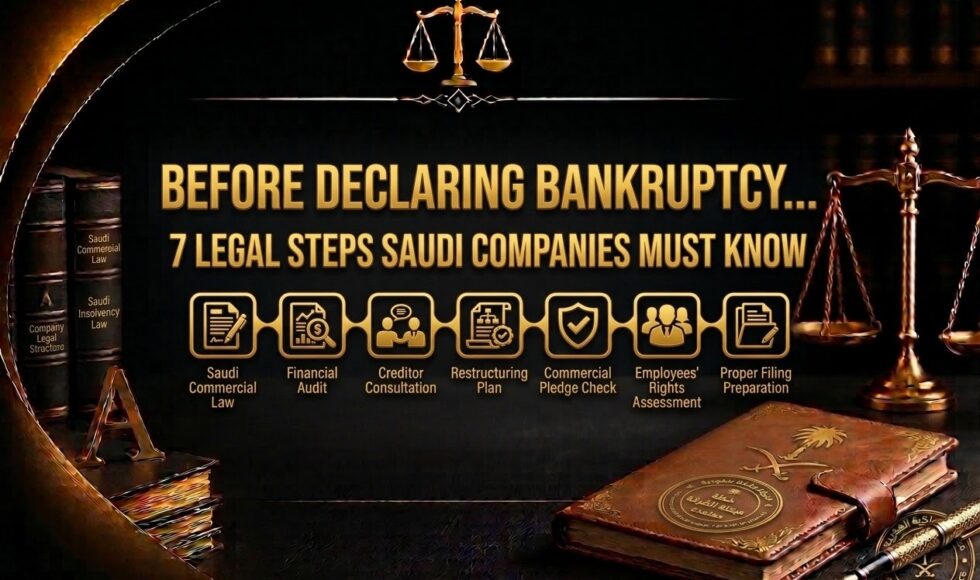
Before Declaring Bankruptcy in Saudi Arabia: 7 Legal Steps Companies Should Know
Introduction: Is Bankruptcy the Only Solution for a Distressed Company?
When a company faces financial distress in Saudi Arabia and its debts begin to accumulate, declaring bankruptcy may seem like the only way out of the crisis. However, the legal framework is more complex. Bankruptcy is not a single procedure, nor does it necessarily mean the end of the business or the closure of the company.
The Saudi Bankruptcy Law aims to regulate the affairs of debtors facing financial disruption, distress, or bankruptcy, while protecting creditors’ rights, maximizing asset value, and providing opportunities for business continuity where possible.
The Saudi bankruptcy framework includes several procedures, most notably Preventive Settlement, Financial Reorganization, and Liquidation, in addition to procedures specifically designed for small debtors and administrative liquidation.
Therefore, dealing with a financial crisis should not begin with the question:
“How do I declare bankruptcy for my company?”
Instead, it should begin with a more important question:
“What is the most appropriate legal procedure for my company’s situation, and can the financial distress be addressed before reaching liquidation?”
This article discusses 7 important legal steps that companies in Saudi Arabia should know before applying to commence bankruptcy proceedings.
Is Bankruptcy the Only Solution for a Financially Distressed Company?
No.
This is one of the most important points that company owners and managers should understand.
In some cases, financial distress can be addressed through procedures aimed at restructuring obligations and reaching an agreement with creditors while maintaining business operations. In other cases, liquidation may be the most appropriate option when there is no realistic prospect of continuing the business.
The key procedures include:
Preventive Settlement
Preventive Settlement aims to facilitate an agreement between the debtor and its creditors to settle debts while allowing the debtor to continue managing its business in accordance with the applicable legal provisions.
Financial Reorganization
Financial Reorganization aims to assist the debtor in reorganizing its financial position and business and reaching an agreement with creditors, with the involvement of a Financial Reorganization Trustee in accordance with the applicable procedure.
Liquidation
Liquidation focuses on identifying creditors’ claims, managing and selling the bankruptcy estate’s assets, and distributing the proceeds to creditors according to the applicable legal priorities and rules.
Therefore, a company should not make a decision simply under the heading of “declaring bankruptcy” before determining which procedure best fits its financial and legal position.
Step One: Accurately Assess the Company’s Financial Position
Before taking any decision regarding bankruptcy proceedings in Saudi Arabia, the company should have a clear and accurate understanding of its financial position.
Start by identifying:
- Total debts and liabilities.
- Names of creditors.
- Debt maturity dates.
- Company-owned assets.
- Future liabilities.
- Cash flows.
- Ongoing contracts.
- Salaries and employee entitlements.
- Government and tax obligations, where applicable.
- Pending lawsuits and claims.
- Obligations relating to guarantees and sureties.
Simply looking at the company’s current bank balance is not enough.
The company may have assets, contracts, or future revenue streams that make financial reorganization possible despite a current liquidity crisis.
On the other hand, a financial assessment may reveal that the problem is more fundamental and that continuing the business is no longer commercially viable. In that case, liquidation may need to be considered more seriously.
Step Two: Determine Whether the Company Is Distressed or at Risk of Distress
A common mistake is to wait until the company has completely stopped making payments before taking action.
A company’s financial position may already be experiencing financial disruption or a risk of default before actual payment default occurs.
The company should therefore assess:
- Its ability to meet current obligations.
- Its ability to pay short-term debts.
- Expected cash flows.
- Debts falling due in the coming months.
- The likelihood that the financial crisis will continue.
- The business’s ability to generate future revenues.
Why Is Early Action Important?
Waiting until the company reaches a complete financial breakdown may result in:
- Fewer available options.
- Increased debts and creditor claims.
- Loss of important assets or contracts.
- Increased disputes with creditors.
- Greater difficulty restructuring the business.
Therefore, early assessment of financial distress may be more effective than waiting until the crisis becomes severe.
Step Three: Do Not Choose a Bankruptcy Procedure Before Considering the Available Options
Not every financial difficulty means that a company should immediately proceed to liquidation.
The Saudi Bankruptcy Law provides several procedures with different objectives and legal effects.
Preventive Settlement
This procedure focuses on reaching an agreement with creditors regarding the settlement of debts while allowing the debtor to continue managing its business in accordance with the law.
Financial Reorganization
This procedure focuses on reorganizing the company’s financial position and business and reaching an agreement with creditors within the procedure and under the supervision of a Financial Reorganization Trustee.
Liquidation
Liquidation focuses on managing and selling the bankruptcy estate’s assets and distributing the proceeds among creditors in accordance with the applicable legal provisions.
Therefore, the right question is not:
“How do I declare bankruptcy for my company?”
It is:
“Which bankruptcy procedure best fits my company’s financial position, objectives, and prospects for continuing its business?”
Step Four: Prepare the Information and Documents Before Filing
One of the most important steps is preparing a complete legal and financial file for the company.
Bankruptcy proceedings may require different information and documents depending on the type of procedure and the nature of the debtor.
The company may need to organize documents and information such as:
- Articles of incorporation, bylaws, and amendments.
- Relevant licenses.
- Financial statements.
- Accounting records.
- A schedule of debts and creditors.
- A schedule of assets.
- Key contracts.
- Employee information and related obligations.
- Pending lawsuits and claims.
- Documents relating to guarantees.
- Information concerning the company’s financial position.
The company should also prepare a clear picture of its financial and commercial position during the preceding period, in accordance with the applicable statutory and regulatory requirements for the relevant procedure.
Important Tip
Do not wait until the company formally decides to commence bankruptcy proceedings before collecting the documents.
Preparing the file early can help identify problems and assess the available options more accurately.
Step Five: Review Contracts and Obligations Before Making a Decision
Financial distress is not limited to debts.
A company may have important contracts with:
- Suppliers.
- Customers.
- Banks.
- Landlords.
- Contractors.
- Employees.
- Partners.
- Service providers.
The company should therefore review its key contracts and ask:
Which contracts are essential to continuing the business?
What ongoing obligations does the company have?
What could be the potential impact of financial distress on these contracts?
Are there termination, default, or guarantee provisions connected to financial distress?
Are there contracts that represent a major source of the company’s revenue?
Some contracts may be extremely valuable to the company’s future. Mishandling them without proper legal analysis could therefore affect the company’s ability to reorganize and continue operating.
Step Six: Protect Company Assets and Avoid Arbitrary Transactions
When a company faces financial difficulties, some managers may consider selling assets, transferring ownership, or paying certain creditors without fully assessing the legal consequences.
This is where the company should stop and seek advice before taking any significant action.
Transactions involving company assets and funds during a period of financial distress may have important legal consequences, particularly if they could affect creditors’ rights or future bankruptcy proceedings.
Accordingly, the company should:
- Document financial transactions and decisions.
- Retain supporting documentation for every transaction.
- Avoid transferring assets without a clear commercial justification.
- Never conceal assets or information.
- Review asset sales or ownership transfers before executing them.
- Document significant management decisions.
- Obtain legal advice whenever there is uncertainty regarding the consequences of a transaction.
The worst outcome is for an attempt to address financial distress to create an additional legal problem.
Step Seven: Consult a Lawyer and Accountant Before Filing
Engaging qualified professionals can be one of the most important steps before making a decision regarding bankruptcy proceedings.
A lawyer can assess:
- The company’s legal position.
- The appropriate legal procedure.
- Contracts and obligations.
- Creditors’ rights.
- Legal risks.
- Previous transactions involving assets.
- Required documents.
- Potential judicial proceedings.
- The company’s relationship with creditors.
Meanwhile, a certified public accountant or financial advisor can assist with:
- Financial analysis.
- Preparing financial statements and records.
- Assessing assets and liabilities.
- Analyzing cash flows.
- Assessing the company’s ability to continue operating.
- Preparing financial information required for decision-making.
Guidance concerning preparation for bankruptcy proceedings also emphasizes the importance of obtaining assistance from qualified professionals in their respective fields.
What About Communicating With Creditors?
Managing relationships with creditors is an important part of handling a financial crisis.
A distressed company may have numerous creditors, each with different documents, deadlines, and requirements.
It is therefore useful to prepare a comprehensive creditor register, such as:
| Information | Details |
|---|---|
| Creditor’s name | Entity or individual |
| Debt amount | Amount due |
| Due date | Payment deadline |
| Type of debt | Commercial, financing, contractual, etc. |
| Documents | Contracts, invoices, correspondence |
| Claim status | Confirmed or disputed |
| Security | If applicable |
This register helps provide an accurate picture of the company’s total liabilities and facilitates an assessment of the available options when selecting the appropriate legal procedure.
Can a Company Be Rescued Before Liquidation?
Yes, in some cases.
One of the objectives of the bankruptcy framework is to provide mechanisms that can help address financial disruption and maintain business operations when the conditions for continuation exist.
Accordingly, Preventive Settlement or Financial Reorganization may be appropriate for some companies experiencing financial difficulties but still operating a viable business.
However, business continuity is not guaranteed in every case.
It depends on factors such as:
- The company’s financial position.
- The value of its assets.
- Its ability to generate revenue.
- The level of its liabilities.
- The creditors’ position.
- The feasibility of implementing a reorganization plan.
- Compliance with the applicable legal requirements.
For this reason, early intervention may be more effective than waiting until the company reaches a stage where saving the business becomes extremely difficult.
Can a Company File for Bankruptcy Itself?
Depending on the procedure and applicable legal requirements, yes.
In certain circumstances, a debtor may apply to commence bankruptcy proceedings, including:
- Preventive Settlement.
- Financial Reorganization.
- Liquidation.
- Certain other procedures in accordance with the applicable provisions.
Procedures specifically applicable to small debtors have separate requirements and mechanisms depending on the type of procedure.
Before filing, the company should therefore confirm:
Type of procedure + satisfaction of legal requirements + complete documentation + correct legal filing process.
Mistakes to Avoid Before Declaring Bankruptcy
Certain actions can make a financial crisis more complicated. Common mistakes include:
1. Waiting Until the Company Completely Stops Operating
Delaying the assessment of available options may allow the crisis to worsen.
2. Concealing Information or Providing Inaccurate Data
Transparency and accurate information are important elements in bankruptcy proceedings.
3. Transferring Assets Without Proper Analysis
This may create additional legal risks.
4. Favoring One Creditor Over Another Without Legal Assessment
This is particularly important when the company is in serious financial difficulty.
5. Neglecting Contracts
Some contracts may be essential to continuing or restructuring the business.
6. Ignoring Creditors
Organized communication with creditors can contribute to better crisis management.
7. Choosing a Procedure Based Solely on Its Name
Preventive Settlement, Financial Reorganization, and Liquidation are not identical procedures.
When Is the Right Time to Take Action?
There is no single rule applicable to every company.
However, signs such as:
- Accumulating debts.
- Declining liquidity.
- Repeated payment delays.
- Increasing lawsuits and creditor claims.
- Difficulty meeting short-term obligations.
- Reduced ability to finance operations.
- Accumulated losses.
- Risk of termination of key contracts.
- Difficulty obtaining new financing.
should trigger an early legal and financial assessment.
The most important practical rule is:
Do not wait until the company reaches “full bankruptcy” before looking for solutions.
A Hasty Decision or a Well-Considered Legal Decision?
A hasty decision might be:
“The company has too many debts, so we will declare bankruptcy.”
A well-considered decision begins with more precise questions:
How much debt does the company have?
What is the value of its assets?
Can the business continue operating?
What is the position of the creditors?
Which contracts must be preserved?
Is there an opportunity for Financial Reorganization?
Is Preventive Settlement appropriate?
Or has liquidation become the most realistic option?
Answering these questions helps determine the legal path most appropriate for the company.
The Role of a Lawyer Before Bankruptcy
A lawyer’s role does not necessarily begin when the application is filed with the court.
In fact, the period before bankruptcy proceedings are commenced may be one of the most important legal stages.
A specialized lawyer can assist the company with:
- Analyzing its legal position.
- Reviewing contracts and obligations.
- Assessing appropriate bankruptcy procedures.
- Reviewing documentation.
- Evaluating legal risks.
- Managing relationships with creditors.
- Preparing applications and legal memoranda.
- Following proceedings before the competent authorities and courts.
- Advising management on decisions made during financial distress.
Bankruptcy is not simply an electronic form that is submitted online. It is a legal and financial process that can have significant consequences for the company, its assets, creditors, and management.
Conclusion: Before Declaring Bankruptcy, Start With an Assessment
A financially distressed company may have more than one option. Depending on its circumstances and compliance with the applicable legal requirements, it may have an opportunity to reorganize its financial position and continue operating rather than proceed directly to liquidation.
The 7 key legal steps before bankruptcy are:
- Accurately assess the company’s financial position.
- Determine the nature or likelihood of financial distress.
- Assess the available bankruptcy procedures and alternatives.
- Prepare the required information and documents.
- Review contracts and obligations.
- Protect company assets and avoid arbitrary transactions.
- Consult qualified legal and accounting professionals.
Every case is different. Therefore, decisions regarding Preventive Settlement, Financial Reorganization, or Liquidation should not be based solely on general information.
Suleiman Al-Omari Law Firm and Legal Consultations
Legal Advice for Companies Facing Financial Distress and Bankruptcy
Suleiman Al-Omari Law Firm and Legal Consultations provides legal and advisory services to companies and individuals in matters relating to financial distress and bankruptcy proceedings in Saudi Arabia.
Our services include assessing the company’s legal and financial position, reviewing contracts and obligations, evaluating available legal options, preparing and following up on relevant proceedings, and representing clients before the competent authorities in accordance with the laws applicable in the Kingdom of Saudi Arabia.
Is Your Company Facing Financial Distress?
If your company is experiencing:
- Accumulating debts.
- Difficulty meeting financial obligations.
- Creditor claims.
- A liquidity crisis.
- Financial or commercial disputes.
- Or is considering Preventive Settlement, Financial Reorganization, or Liquidation,
obtaining early legal advice may help you understand your available options and reduce potential risks before taking the next step.
Contact Suleiman Al-Omari Law Firm and Legal Consultations to assess your company’s situation and evaluate the appropriate legal options.
Legal Disclaimer: This article is provided for general informational purposes only and does not constitute legal advice. Requirements, procedures, and legal consequences may vary depending on the type of debtor, the applicable procedure, the facts, and the relevant documents. Laws and regulations may also be amended from time to time. Professional legal advice and review of the applicable legislation are therefore recommended before taking any action.
Contact Us
📞 +966 53 777 8130
Or contact us via WhatsApp:
You can also contact us via WhatsApp:
Suleiman Al-Omari Law Firm for Legal Services and Consultations