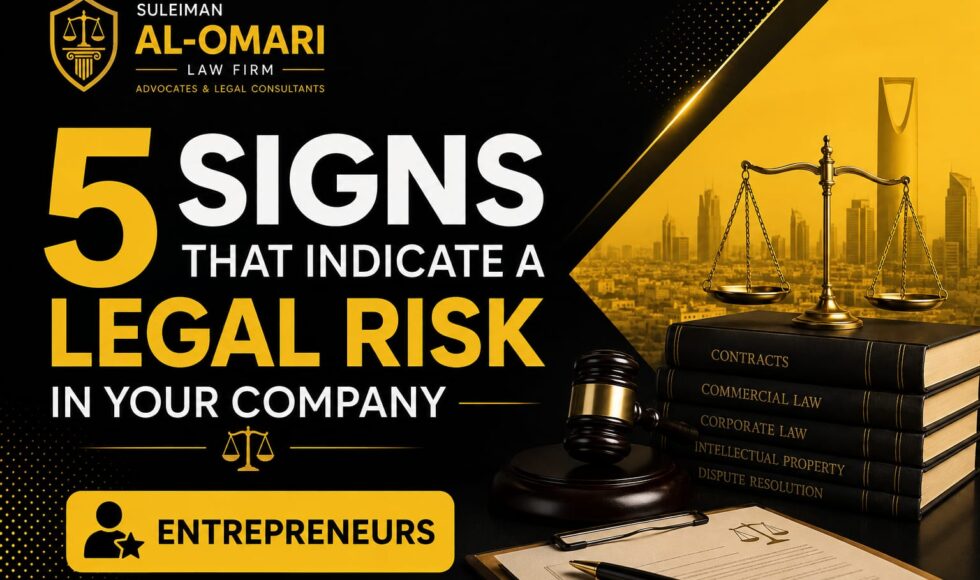
5 Signs Your Company May Face Legal Risks and How to Deal with Them
A successful entrepreneur does not wait for a problem to arise before looking for a solution. Instead, they identify legal risks early—before they turn into disputes and costs that could affect the company’s operations.
In the business environment of the Kingdom of Saudi Arabia, legal management has become an important part of maintaining business stability and continuity. Contracts, partnerships, financial obligations, intellectual property, and the company’s relationships with customers, employees, and suppliers are all areas that may give rise to legal consequences if not properly managed.
The Saudi legislator has regulated many of these areas through specialized laws and regulations, including the Companies Law, the Trademarks Law, and the Copyright Law, among others.
So, what are the key signs that may indicate the presence of a legal risk within a company? And how can entrepreneurs address these risks before they escalate?
What Are Legal Risks for Companies?
Legal risks are problems or circumstances that may lead to a dispute, claim, or legal liability as a result of non-compliance with applicable laws and regulations, or due to deficiencies in contracts, procedures, documentation, rights, or obligations.
A company does not necessarily have to be involved in court proceedings for a legal risk to exist.
A problem may begin with:
- An unclear contract.
- A verbal agreement that was never documented.
- A financial entitlement that was not properly evidenced.
- The use of a trademark without verifying its legal status.
- Ignoring a legal claim or notice.
- A partnership in which the parties’ rights and obligations were not clearly defined.
For this reason, legal prevention is no less important than dealing with a dispute after it occurs.
The First Sign: Relying on Unclear or Outdated Contracts
One of the most common sources of legal risk within companies is relying on outdated contracts or unclear templates that no longer reflect the current nature of the relationship between the parties.
A company may continue using a contract that was prepared years ago even though its business activities or relationships with customers and suppliers have changed, while the contract remains unchanged.
Where Does the Problem Lie?
A contract is one of the most important tools for defining the rights and obligations of the parties.
When its provisions are unclear, important questions may arise if a dispute occurs, such as:
- What is each party’s obligation?
- What is the agreed term?
- How can the contract be terminated?
- Which party bears liability in the event of a breach?
- How should delays be addressed?
- What is the dispute resolution mechanism?
- What financial amounts may each party be entitled to claim?
- What are the limits of liability and compensation, subject to applicable law?
The more complex the business relationship, the more important proper contract drafting and review become.
How Can a Company Reduce This Risk?
A company should not simply ensure that a contract exists. It should also ensure that the contract is clear, appropriate to the nature of the relationship, and updated when necessary, and that it is reviewed before signing, renewal, or making material amendments.
The Second Sign: Entering into Partnerships Without Properly Documented Agreements
A partnership can be one of the most important factors contributing to a business’s success. At the same time, it can become a source of dispute if the parties’ rights and obligations are not clearly defined.
One common mistake some entrepreneurs make is relying on trust and personal relationships instead of formally documenting and organizing the relationship in writing.
What Should Partnership Agreements Clarify?
Depending on the nature of the partnership, key matters should be clearly addressed, including:
- Each partner’s ownership percentage.
- Each party’s contribution.
- Management responsibilities.
- Decision-making procedures.
- Distribution of profits and losses in accordance with the applicable legal and contractual framework.
- Mechanisms for resolving disputes.
- Conditions for admitting a new partner or the exit of an existing partner.
- The transfer of shares or ownership interests, depending on the type of company.
- Procedures for terminating the relationship when agreed conditions arise.
These matters fall within the framework governing companies in the Kingdom. The Companies Law establishes the legal framework for different types of companies, including their management, organization, and the rights of the parties, depending on the type of company.
Why Is Documentation Important?
A disagreement that begins with a simple question such as “What did we agree on?” can develop into a lengthy dispute if the parties’ agreements, rights, and obligations are not clearly documented.
Therefore, documenting the relationship from the outset does not indicate a lack of trust between partners. Rather, it is a means of organizing the relationship and protecting the interests of all parties.
The Third Sign: Delaying the Documentation and Follow-Up of Financial Entitlements
Un documented financial entitlements, or financial obligations that are not properly organized and followed up, can develop into commercial and legal problems.
A company may provide services or supply products to a customer, only for payment to be delayed. When the company eventually seeks payment, it may discover problems with invoices, correspondence, delivery records, or other evidence of the obligation.
Where Does the Risk Lie?
The longer a company delays organizing and documenting its financial entitlements, the greater the possibility of difficulties in managing the relevant files and proving the details of the financial relationship when necessary.
Companies should therefore pay attention to:
- Contracts.
- Invoices.
- Purchase orders.
- Proof of delivery.
- Delivery and acceptance records.
- Correspondence.
- Payment acknowledgments and agreements.
- Accounting records.
- Any other documents related to the transaction.
Companies should also have a clear internal system for monitoring accounts receivable and outstanding debts, together with a defined process for dealing with late payments.
Do Not Wait Until Debts Accumulate
Managing financial entitlements does not begin after a customer fails to pay. It begins when the commercial relationship is established by defining payment terms, the parties’ obligations, and follow-up procedures.
The Fourth Sign: Using Trademarks or Content Without Verifying Intellectual Property Rights
Another legal risk that some business owners may overlook is the use of content, images, designs, or trademarks without verifying the rights associated with them.
This may include:
- Using images found online in advertising campaigns.
- Copying content from other websites.
- Using designs without identifying the rights holder.
- Using a logo that is similar to another trademark.
- Launching a trademark without conducting appropriate searches before using or registering it.
- Using marketing or creative content produced for another party without verifying the relevant exploitation or usage rights.
Intellectual property in Saudi Arabia is subject to a legal framework, including the Copyright Law, which addresses protected works and related rights. The applicable GCC Trademark Law also regulates matters relating to trademark registration, protection, transfer of ownership, licensing, and enforcement of relevant rights in the Kingdom.
Why Should Companies Pay Attention to This?
A trademark and creative content are not merely marketing assets. They may be associated with valuable legal and financial rights.
Unauthorized use may result in claims or legal proceedings, depending on the nature of the violation and the rights involved.
Therefore, before using any trademark or content, a company should verify the source of the rights, the scope of the license, and the permitted uses, while also taking appropriate steps to protect its own intellectual property assets.
The Fifth Sign: Ignoring Legal Disputes or Claims in the Hope That They Will Go Away
One of the mistakes that can make a legal situation more complicated is ignoring a problem in the hope that it will resolve itself.
A company may receive:
- A financial claim.
- A legal letter.
- A notice from a contracting party.
- A demand for termination of a contract.
- An allegation of breach of an obligation.
- A claim relating to a trademark or content.
- A dispute with a partner, supplier, or customer.
- A lawsuit or judicial proceeding.
In some cases, delaying action may result in the company missing an opportunity to resolve the issue at an early stage.
The Commercial Courts Law also regulates proceedings relating to various disputes falling within the jurisdiction of the commercial courts, including provisions concerning the preparation of claims, submission of memoranda and documents, and litigation procedures.
What Should a Company Do When It Receives a Legal Claim?
It is generally better not to ignore the claim or provide an arbitrary response before understanding its substance.
Instead, the company should:
- Review the claim and related documents.
- Identify the basis of the dispute.
- Review the relevant contract or business relationship.
- Collect relevant documents and correspondence.
- Identify the rights and obligations of each party.
- Assess the available options for addressing the dispute.
- Take the appropriate action within the applicable timeframe.
The objective is not always to go to court. In some cases, negotiation, settlement, or remedying a breach may be the most appropriate solution, while other situations may require regulatory or judicial action.
Does the Presence of One of These Signs Mean That the Company Has a Legal Case?
Not necessarily.
Having an outdated contract, receiving a customer claim, or using content from an external source does not automatically mean that a violation or legal liability exists.
However, these are indicators that deserve review.
The proper legal assessment depends on the specific circumstances of each case, the nature of the relationship between the parties, the available documentation, and the applicable laws and regulations.
Therefore, an important legal decision should not be based solely on general information or an awareness article.
How Can You Protect Your Company from Legal Risks?
Companies can adopt a number of preventive measures to help reduce legal risks, including:
1. Review Contracts Regularly
Do not rely on a single contract template for all transactions without considering the specific nature of each relationship.
2. Document Business Relationships
Maintain clear documentation for important business relationships, whether with partners, customers, suppliers, or service providers.
3. Organize Financial Entitlements
Keep all documents related to each transaction and monitor debts and financial entitlements through a clear and organized system.
4. Protect Intellectual Property
Verify the rights associated with the use of trademarks, content, designs, images, and other intellectual property assets.
5. Address Disputes Early
Do not wait until a problem develops into a larger dispute before assessing the situation.
6. Review Regulatory Compliance
A company should periodically review its legal and regulatory position according to the nature of its business and the laws and regulations applicable to its activities.
7. Seek Professional Advice When Necessary
Certain matters may require specialized legal advice, particularly where the value of a dispute is significant or where the matter involves an important contract, partnership, legal claim, or intellectual property right.
Why Is Periodic Legal Review Important for Entrepreneurs?
Entrepreneurs may become focused on growth, sales, marketing, financing, and expansion, while legal matters move down the list of priorities.
The problem, however, is that some legal risks do not reveal their consequences until much later.
A contract signed today may become the basis of a dispute a year from now.
A partnership that began with mutual trust may face disagreements as the business expands.
A trademark used without proper review may later become the subject of an intellectual property dispute.
A financial entitlement that was not properly monitored may eventually become a burden on the company’s cash flow.
Therefore, preventive legal review can help business owners identify weaknesses before they develop into larger problems. The scope of the required legal review will vary depending on the company’s activities, structure, contracts, and obligations.
Legal Risk Can Start with a Small Detail
Business owners should understand that legal risk does not always begin with a lawsuit.
Sometimes, it starts with a small detail that did not receive sufficient attention:
A contract that was not reviewed, an agreement that was not documented, an outstanding payment that was not followed up, a trademark that was not verified, or a legal claim that was ignored.
Over time, these details can accumulate and affect the company financially, operationally, and legally.
Therefore, establishing a well-organized legal environment within a company is not a luxury; it is an important element of sound risk management.
Sulaiman Al-Omari Law Firm — Legal Support for Entrepreneurs and Companies
Entrepreneurs need to focus on developing their businesses and achieving growth. However, this should not come at the expense of the legal aspects governing their activities.
This is where Sulaiman Al-Omari Law Firm provides specialized legal services to support entrepreneurs and companies and assess legal matters relating to their businesses in accordance with the laws and regulations applicable in the Kingdom of Saudi Arabia.
Depending on the circumstances of each case, the firm provides legal services in various areas, including:
- Reviewing and drafting contracts and agreements.
- Assessing commercial partnerships and business relationships.
- Handling legal disputes and claims.
- Corporate matters, including company formation and organization.
- Intellectual property and trademark matters.
- Commercial claims and disputes.
- Legal support for entrepreneurs and businesses.
Each matter is handled based on an assessment of its facts and documents and the identification of the relevant applicable laws and regulations, through lawyers and legal and Sharia consultants.
Conclusion
The presence of a legal risk within a company does not necessarily mean that a lawsuit or violation already exists. However, it may be an indicator that deserves attention before the situation develops further.
The key warning signs include:
1. Unclear or outdated contracts.
2. Partnerships that are not properly documented.
3. Delays in documenting and following up on financial entitlements.
4. Using trademarks or content without verifying the relevant rights.
5. Ignoring legal claims or disputes.
The most important rule for every entrepreneur is:
Do not wait for a problem before looking for a solution. Review your company’s legal position regularly and identify potential risks before they develop into disputes and greater costs.
For an accurate legal assessment, it is advisable to consult qualified professionals and review the facts, documents, and applicable laws and regulations of each case, as the appropriate solution varies from one situation to another.
Sulaiman Al-Omari Law Firm provides specialized legal services through lawyers and legal and Sharia consultants, supporting companies and entrepreneurs and helping protect their interests in accordance with the applicable laws and regulations of the Kingdom of Saudi Arabia.
Contact Us
📞 +966 53 777 8130
You can also contact us via WhatsApp here.
Legal Disclaimer: This article is intended for general legal awareness purposes only and does not constitute a substitute for specialized legal advice. Legal provisions and procedures vary depending on the facts of each case, the relevant documents, and the applicable laws and regulations.